
Women in Tech in Switzerland: The Talent Is There. So Why Isn't It Reaching the Workforce?
A new preliminary study by the Lucerne University of Applied Sciences and Arts (HSLU) provides an evidence-based picture of women’s participation in Switzerland’s ICT education and workforce. Its findings point to a persistent gap between education and employment – and raise important questions about where change is needed.
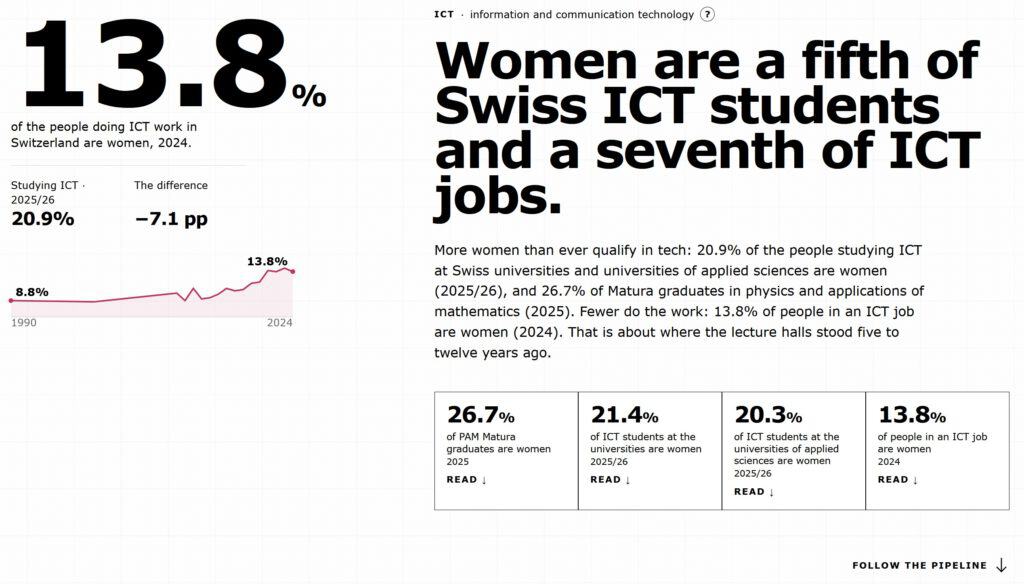
Switzerland has made progress in getting more women into technology education. But that progress is not translating into the workforce at the same pace. The figures in the preliminary study of the Women in Tech Index Switzerland make this particularly clear: women account for 20.9% of people studying ICT at Swiss universities and universities of applied sciences in 2025/26. Yet they make up only 13.8% of people working in ICT occupations, based on 2024 data.
In other words, the proportion of women working in ICT today is roughly where the lecture halls stood five to twelve years ago.
This is more than a question of representation. Switzerland’s technology sector plays an important role in the country’s competitiveness and innovation capacity. As demand for qualified professionals grows and AI reshapes skills and roles, the ability to attract, retain and develop talent matters.
Women’s participation in technology is therefore not only an issue of equity, but also one of talent, competitiveness and innovation.
More Women Are Choosing Technology – but the Workforce Is Not Keeping Pace
The study, carried out at the Lucerne University of Applied Sciences and Arts, brings together publicly available data from different sources to establish a baseline of women’s participation in ICT in Switzerland.
There are encouraging developments in education. The share of women studying ICT has increased significantly over the past decades. In 2025/26, women account for 21.4% of ICT students at universities and 20.3% at universities of applied sciences. The number of women studying ICT has grown more than ninefold at both types of institution compared with the late 1990s and 2000.
The picture looks different when it comes to employment. According to the study, women represent 13.8% of people working in ICT occupations in 2024. This figure has barely changed since 2021.
Where Does the Pipeline Lose Women?
Looking at the different stages of education and employment, the study identifies two points where the share of women is notably lower.
The first is the transition from academic secondary education into an ICT degree. In the latest cohort window analysed, women make up 23.9% of graduates with a Matura in physics and applications of mathematics, but only 15.9% of students entering an ICT bachelor’s programme at a university.
The second gap appears between education and employment. The share of women rises again during university studies, reaching 20.1% among ICT master’s graduates, but falls to 13.8% among people working in ICT occupations.
The vocational route into technology shows a different pattern at the point of entry: the share of women entering ICT bachelor’s programmes at universities of applied sciences is higher than the share of women with a technical vocational Matura. However, this route also sees a decline at the transition into employment.
These figures point to stages that deserve closer attention. They do not, however, follow the same individuals throughout their education and careers. Switzerland does not currently have a national dataset that tracks people from school through graduation and into employment. The study therefore identifies where the proportions differ, but cannot establish exactly why.
Getting Into Tech Is Only Part of the Story
The study also looks at what happens to women who are already working in ICT.
In 2024, the estimated registered unemployment rate for women in ICT was 2.92%, compared with 2.26% for men. The difference has persisted throughout the period analysed, from 2011 to 2024.
Career progression is another area worth examining. Five years after completing an ICT master’s degree, 21.3% of women hold a position with a management function, compared with 23.6% of men. The difference is smaller than the corresponding gap outside ICT, but it still shows that the question is not only who enters the field, but also what opportunities people have once they are there.
The study does not provide data on an ICT-specific gender pay gap, nor can it explain why women leave or remain in the field. These are important gaps in the available evidence and underline the need for more comprehensive and regularly updated data.
From Fragmented Data to Informed Action
One of the main purposes of the preliminary study is to lay the analytical and methodological groundwork for a future Women in Tech Index Switzerland.
Relevant data already exists, but it is spread across different sources, classifications and time periods. A consistent benchmark could make it easier to track developments, identify where talent is being lost and understand where action may have the greatest impact.
The study was carried out by the Lucerne University of Applied Sciences and Arts, with a working group involving TechFace, Women in Tech Switzerland, Women in Robotics Switzerland and Women in Data Science Zürich. Its advisory group brought together practitioners from these communities to help shape the scope and focus of the work.
The current study focuses on ICT. Future editions are intended to broaden the scope to STEM.
There are also clear limitations to acknowledge. The underlying official datasets generally record gender as either woman or man, meaning people who identify outside this binary are not represented in the published figures. The study is descriptive rather than causal: it shows what the data reveal, but does not establish why the trends occur or attribute them to particular initiatives or policies.
The Next Step:
Turn Visibility Into Action
The findings offer a useful starting point for a broader conversation. Encouraging more girls and women to consider technology careers remains important. But the data suggest that focusing only on education and recruitment is not enough.
Companies, educational institutions, policymakers and the wider tech community also need to look at what happens after people enter the field. Are there working environments in which women can develop and build long-term careers? Are career paths and leadership opportunities accessible? What barriers exist at the transition from education to employment? And what additional data would help answer these questions?
There is no single answer in this preliminary study. Its value lies in making the gaps visible and providing a common evidence base from which to ask better questions.
The talent is there. The challenge is to create the conditions in which it can contribute, grow and shape the future of technology.
Explore the preliminary study of the Women in Tech Index Switzerland:
The report is publicly accessible and includes the data, methodology, findings and a directory of Swiss organisations working to support women in technology.